
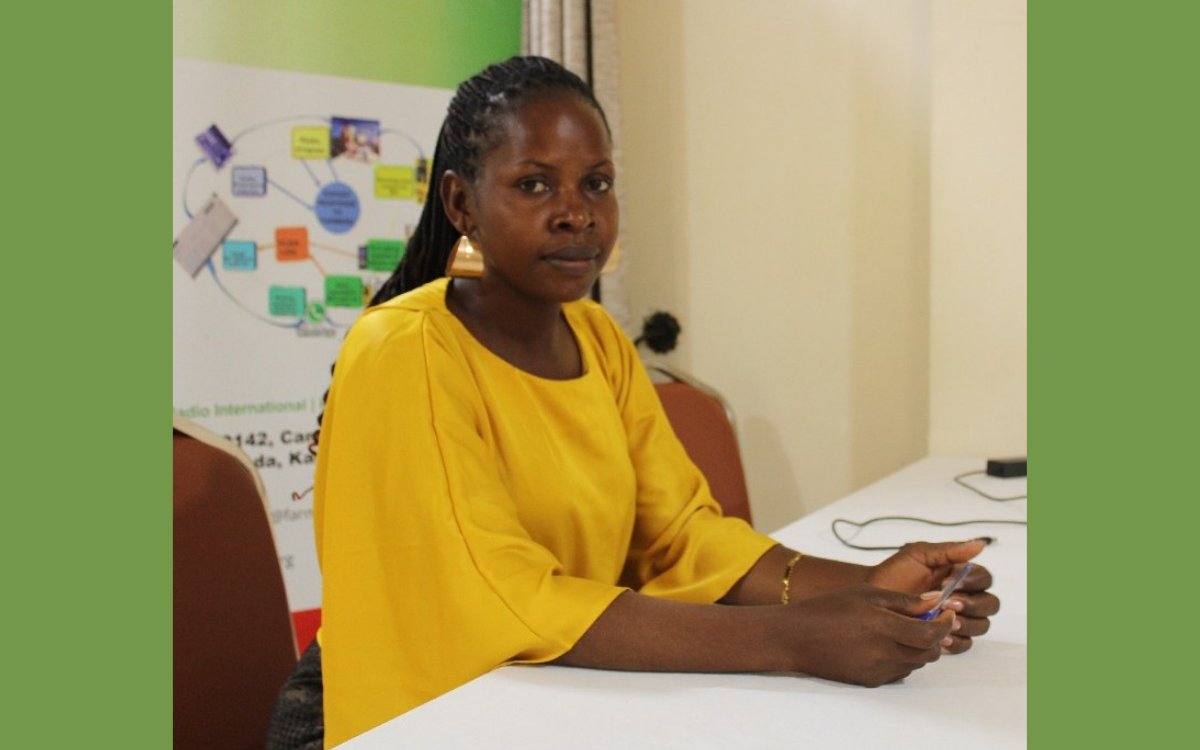
In Jinja city, Uganda, radio journalist Faridah Namulondo has found herself transformed not only as a broadcaster but also as a farmer. At 37, Mrs. Namulondo serves as deputy news editor and station news reporter at NBS Kodheyo FM (89.4 FM). With a degree in Mass Communication and Journalism from Kampala University, she has long been dedicated to sharing useful information with her community. But her involvement in the Platform project has taken her work to another level.
Farm Radio International first identified NBS Kodheyo FM as a key station to host interactive agricultural programming. Mrs. Namulondo now reports for the Green Leaf Magazine (GLM), a weekly one-hour program produced with support from a local district hub. The show, broadcast in Lusoga, features farming news, weather, market updates, and expert interviews with agricultural specialists and farmers.
She says, “ The program provides practical solutions to farming challenges.” Listeners share positive feedback through calls, text messages, and the ULIZA platform. One farmer, Florence Nakaziba from Buyengo Town Council, said she learned to make organic manure after listening to the program.
For Mrs. Namulondo , the project has been equally life-changing. She says, “It has transformed me into an actual farmer. I now have my own garden, which I work on with passion, thanks to what I’ve learned from the program.”
She also credits the project with improving her journalism skills. Before, she focused mainly on studio reporting. But working on the GLM pushed her into the field, where she learned to conduct spontaneous, farmer-centered interviews that felt more authentic and impactful. Her work even opened new doors into business journalism at NBS FM.
Mrs. Namulondo says she is grateful to Farm Radio International and partners for their continued support. She encourages fellow broadcasters to embrace collaborative production, thorough research, and ongoing training to ensure that programs remain relevant and empowering for farmers.
